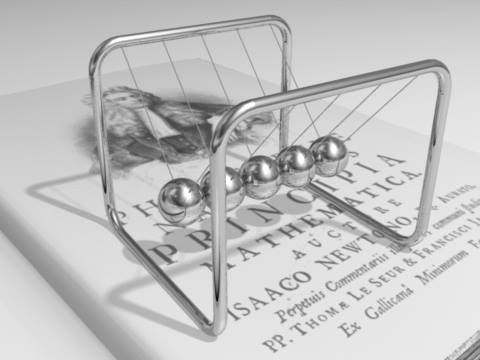
The Newton’s cradle

Fun Science: The Newton’s cradle is a device that demonstrates conservation of momentum and energy via a series of swinging spheres. If one ball is pulled away and is let to fall, it strikes the first ball in the series and comes to nearly a dead stop. The ball on the opposite side acquires most[…]
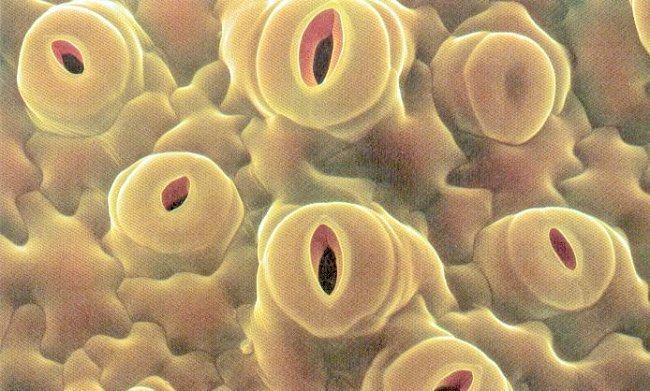
Stomata

Science tip: There are tiny pores on the leaves of a plant called stomata (singular called stoma) where gaseous exchange can occur. Most water loss occurs through the stomata. This explains why when leaves are covered in oil, the water that a plant uses decreases.

Conservation of energy

Science tip: Many questions are about the conservation of energy. Remember that energy cannot be created or destroyed, only converted into other forms of energy. Answers must also be very specific. Instead of saying “The toy car eventually came to a stop because the kinetic energy was lost to its surroundings” you have to specify[…]

Last minute tips for PSLE Maths

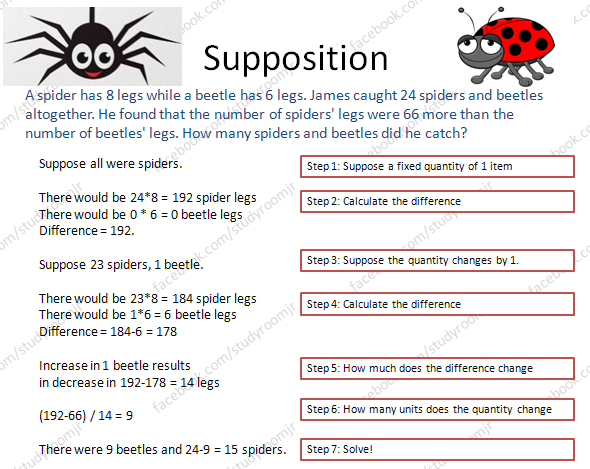
Revision tips Revise the following concepts – they are critical: Fractions, ratios and percentages Geometry – area and circumference of circle, breaking down a composite figure into circle, square, triangle, volume of cube and cuboid. Find unknown angles in squares, rectangles, parallelograms, rhombus, trapezium and triangles. Speed Algebra – representing an unknown with a letter,[…]

Pattern recognition

Maths tip: Here’s an interesting question from one reader. It involves recognising a pattern and extrapolating from there. The pattern may not come easily at first – so try to draw it out and analyse. The question is "A teacher arranged thirty pupils to stand in a row, starting from Number 1 to Number 30.[…]